
 Priya Nair
There is a particular kind of Friday that has nothing to do with laziness. You worked all week. You closed a pile of tickets. The board is a wall of green. Then the person who actually cares about the result asks the only question that matters — is the delivery ready? — and the answer is no.
This page is for the person who owns that delivery end to end: a launch, a client request, an internal change. Three or four other people touch it. You are judged on whether it lands, not on how many cards you moved. It is not a fit if you want a personal to-do list on its own, or one app to replace every app you use.
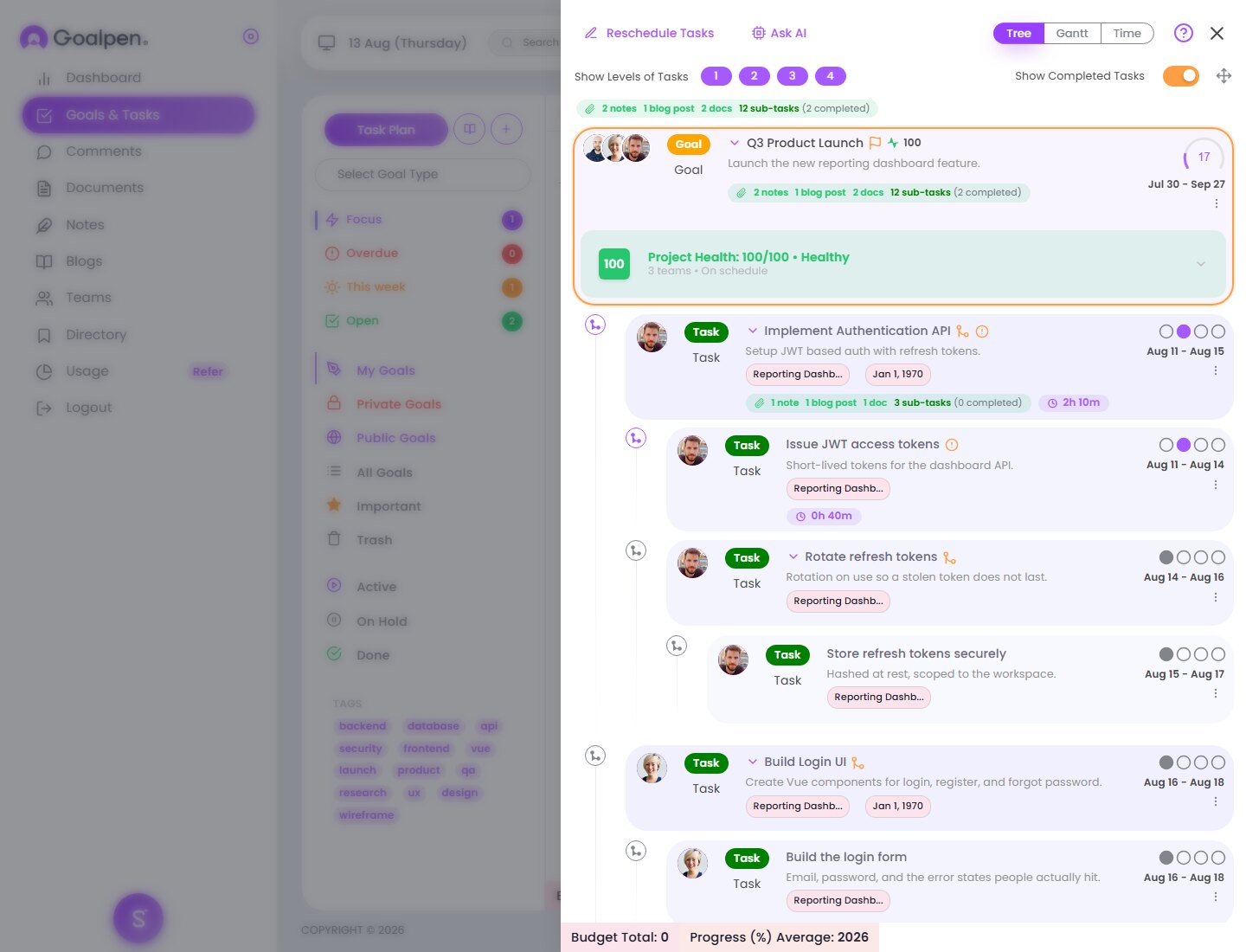
In plain English: Goalpen is a living goal tree. The finish line sits at the root, the real work hangs underneath, and you can see whether the delivery moved — not just whether the board is green.
The week that looks busy and still goes nowhere
Monday's standup runs eleven minutes. Everyone says what they are on. Nothing sounds wrong. Nobody can say whether the intake launch is closer than it was last Monday, because the round is a tour of activity, not a look at the finish.
Tuesday you hand a piece of work to a colleague in chat — a clear message, the files attached, a thumbs-up back. It reads like it started. By Thursday you discover it did not. The message scrolled. The work never had a home.
Wednesday a stakeholder asks for a small change. It genuinely is small, so you say yes. It is the fourth small yes this week. None of the four moved the client any closer to running the new intake without you in the loop. They just made the list longer.
Thursday you spend forty minutes rebuilding a status slide out of two chat threads, a board, and your own memory. The slide is accurate for about a day. Friday someone asks the question, the board is green, and you already know the answer.
Nothing in that week was wasted motion in the ordinary sense. Every hour was real work. The week still left the result where it was on Monday.

If that Friday already sounds familiar, keep reading. The next part is the habit — not a tour of menus.
Why the tools you already have cannot see this
They are very good at recording motion. A card moves. A checkbox flips. A column turns green. Those events are easy to count, so those are the events that get shown.
Nothing in that system holds the thing you are accountable for: whether the end result moved. So the list grows faster than the delivery advances. Waiting stays invisible, because a task parked behind someone else's approval looks identical to one being worked. The calendar fills with meetings whose only job is to rebuild a picture by hand. Eventually someone keeps a private sheet, because the private sheet is the only thing that is true.
Put the finish line where the work lives
You do not need a louder board. You need the outcome sitting in the same place as the work.
In Goalpen that place is a living goal tree. The Goal is the finish line written as a sentence you would defend on Friday — not “ship the project,” but something like “the client can run the new intake without us in the loop.” The real work hangs underneath it as branches. A task that serves nothing you own has nowhere to hang, which is how you see it before you say yes.
- Root — the outcome you would defend on Friday.
- Branches — the work that actually moves it.
- Notes and handoffs — on the node, not in a thread that scrolls away.
Prefer to watch first? See how it works on the homepage.
Take the same week again. Monday's standup starts by opening the root instead of going around the room. Tuesday's handoff is a node with a face on it, not a message that can quietly become nothing. Wednesday's small favour has to hang somewhere, or you can see that it does not. Thursday's slide mostly stops being necessary, because the note explaining why something is stuck sits on the goal, where the next person will look. Friday's question has a real answer: the root moved, or it did not, and you can see why.
The hours sit on the same branch. Start a timer on a task and the tree shows a clock next to the note — not in a separate timesheet. Open Time on a goal and you see who spent what on which branch. That is the living tree in a second colour: the work, the reason, and the time occupy one place.

Try it on one delivery you already own
Write the finish line. Hang the two or three branches that genuinely move it. Put one short note on the root so the reason lives with the work. Next Friday, answer one question on the goal: did the outcome move — yes, no, or blocked, plus a line of why.
The tree works without AI. Hang the branches by hand. When the week changes faster than you can drag rows, Ask AI on the Team and Business plans can draft an amendment in ordinary English — a draft sits beside the live tree until you Apply. A Free workspace sees a demo of that helper, plus an upgrade prompt.
Prefer to talk it through first? Use Contact us. Want the numbers before anything else? Skim Pricing. No hard sell either way.
*Current page check: “the root moved, or it did not” (13 August 2026).*